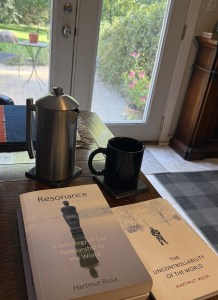
Several people really liked my post on Resonance.
I highly recommend reading Harmut Rosa’s work, though it’s extensive and not easy reading. His book Resonance is over 480 pages long, you have to really be interested in health and flourishing and the modern ills stacked against us to be motivated to dive in. Resonance, as Harmut Rosa defines it, does provide a key response to a unique challenge we have.
Why does there seem to be so much alienation, disconnection, isolation, and muteness?
Rosa brilliantly blames it on 1) social acceleration and 2) the logic of escalation.
What is Resonance? Resonance is the opposite of alienation, the antidote to social acceleration and the logic of escalation.
Modern ideology causes alienation following a pattern something like this:
- We need more stuff- clothes, trips, entertainment, jewelry.
- We need more money to get the stuff.
- We need more work to get the money.
- Repeat number 1-3 indefinitely, ignoring resonance.
Or how about this well-meaning but ultimately self-defeating progressive pattern of thought:
- We need more welfare programs and to take care of the environment and climate change.
- So, we need more taxes to pay for welfare.
- So, we need a higher GDP and growth.
- So, we need more consumption.
- So, we need more work.
- So, we have more trash, more energy consumption, more taxes, more money, more debt, more work, more stress, more welfare, more growth, and on and on and we haven’t done anything for the environment. Actually, we made the environment worse!
Resonance puts a stop to this mindset. It’s a “3rd party” perspective so to speak- in my opinion the smart one.
It forces us to step outside of the dialectical trap all around us.
Resonance is relating to things outside of ourselves, out there in the world, that have a voice of their own.
The most important factor in resonance is the encounter: It speaks, we hear it, and there’s an encounter. It could be music, it could be nature, it could be a specific skill at work, a conversation, a friendship, a place.
There needs to be 3 parts 1) It speaks 2) we respond and 3) we’re changed by it.
The most important thing is that it can’t be manufactured or controlled.
Some things you might think of commonly interacting with- the TV, the phone, the car- seem to not allow us to have this experience, though in some cases I can see how.
Can we respond and be changed by a car that drives itself?
Can we resonate with a phone that is nothing but an extension of ourself?
Can the TV resonate when it is a projection of us- what we want, what we feel like watching?
I’m not so sure. In order for something to speak, it has to have its own voice, like a piece of music does.
A certain piece of music may or may not resonate, but it has a voice, music speaks. Another person speaks. We respond or we don’t.
The modern world, because of social acceleration and the logic of escalation, tends to crowd out Resonance.
If we aren’t regularly searching for resonance, maybe we should be.
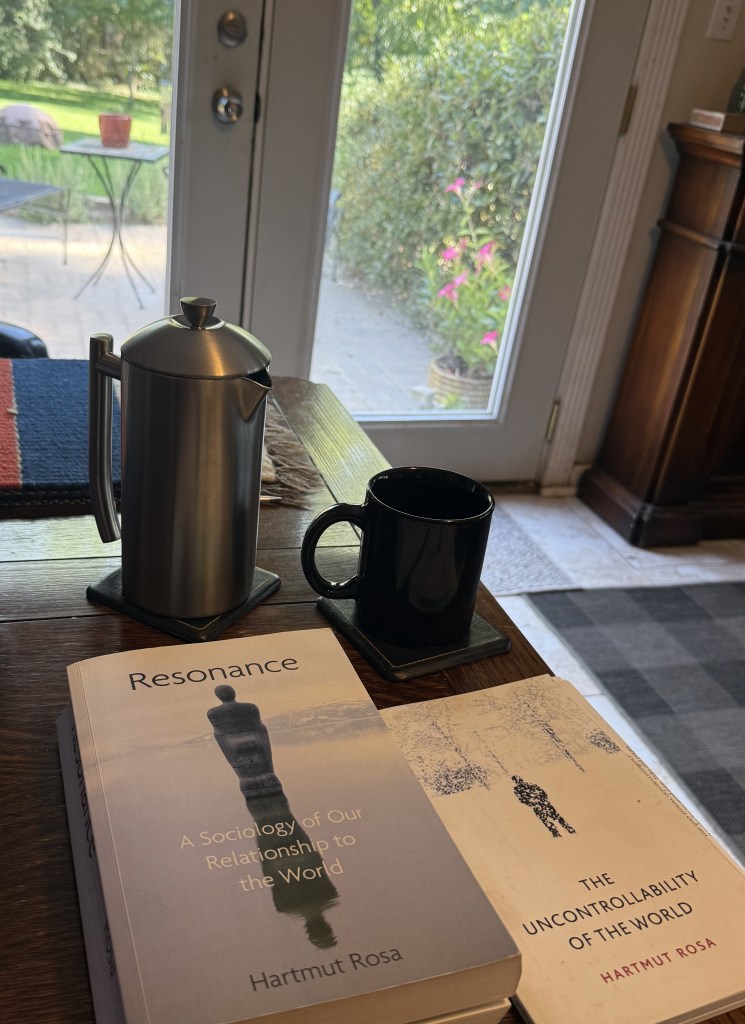
Cooking, and preparing a french press could be a type of resonance. You can’t manufacture coffee completely, not a perfect cup, you have to work with the ingredients to an extent. The coffee has a voice, a way it likes to be prepared, for the perfect cup. Trust me I know! Cooking is that way too, that’s why it resonates with so many people.
Here’s a link to Harmut Rosa on Youtube discussing the topic: